
Dishwasher Not Heating Water? Common Causes and How to Fix It
If your dishwasher is not heating water, the problem may be caused by a faulty heating element, temperature sensor, control board, or hot water supply issue. When water doesn’t reach the proper temperature, dishes may come out dirty, greasy, or poorly rinsed.
Before replacing any parts, it’s important to identify the cause, as heating systems vary between dishwasher models.
KZ Express provides professional appliance repair services in Baltimore, including Baltimore City, Baltimore County, Dundalk, Essex, Middle River, Rosedale, Parkville, Towson, and surrounding Maryland communities. Our technician can inspect your dishwasher, identify the problem, and recommend the appropriate repair.
Quick Information
Difficulty: Moderate
Estimated Check Time: 5–10 Minutes
Tools Needed: Flashlight, Screwdriver
Safety: Turn off and unplug the dishwasher before inspection. Basic checks of the water supply and settings are generally safe, but diagnosing internal heating components may require professional expertise. Avoid opening electrical components or accessing the heating element or the thermistor yourself.
Signs and Symptoms of a Dishwasher Not Heating Water
When a dishwasher is not heating water properly, you may notice several changes in its cleaning and drying performance. The symptoms can help identify a possible heating problem, although they do not always confirm which component has failed.
1. Dishes Come Out Cold After the Wash Cycle
If dishes feel unusually cold after a completed cycle, the dishwasher may not be heating the water to the required temperature. However, this can vary depending on the selected cycle and dishwasher model.
2. Dishes Are Still Dirty or Greasy
Water that is not reaching the proper temperature may reduce the dishwasher’s ability to remove grease, food residue, and detergent buildup from dishes.
3. Dishes Are Not Drying Properly
If dishes remain wet after the cycle, a heating problem may be involved, especially in models that use a heating element for drying. However, some dishwashers use condensation or other drying systems, so wet dishes do not necessarily indicate a faulty heating element.
4. Detergent Is Not Dissolving Completely
If detergent remains in the dispenser or leaves residue on dishes, insufficient water temperature could be one possible cause. A blocked dispenser or water circulation problem can also produce similar symptoms.
5. The Dishwasher Takes Longer to Complete a Cycle
Some dishwasher models may extend the cycle when the water does not reach the expected temperature within a certain period. If your dishwasher takes longer than usual, a heating or temperature-sensing issue may be worth investigating.
6. A Heating-Related Error Code Appears
Some modern dishwashers display error codes when they detect a heating, temperature sensor, or water temperature problem. The meaning of each code depends on the manufacturer and model, so check your owner’s manual before assuming which part has failed.
Important: If you notice several of these symptoms together, your dishwasher may have a heating problem. However, these signs alone cannot confirm whether the heating element, temperature sensor, water supply, or control system is responsible.
Common Causes of a Dishwasher Not Heating Water
If your dishwasher is not heating water, the cause may involve the heating element, temperature sensor, control board, or incoming water temperature. The exact cause depends on the dishwasher’s design and how its heating system operates.
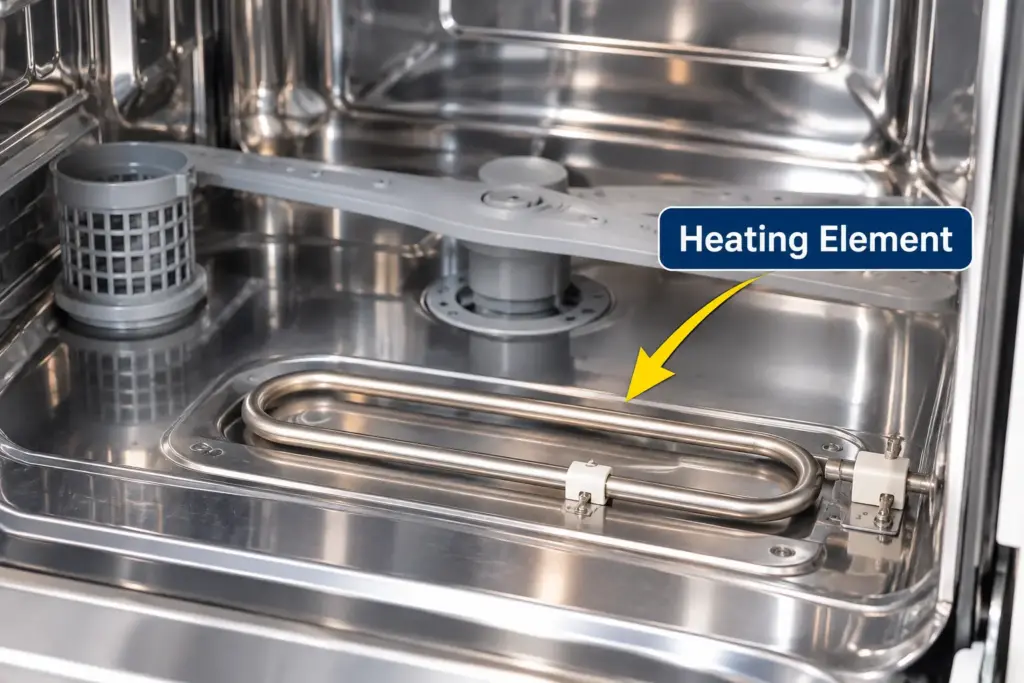
1. Faulty Dishwasher Heating Element
The heating element is responsible for raising the water temperature during certain wash cycles in many dishwasher models. If the element becomes damaged or stops working, the water may remain cooler than expected.
Over time, heating elements can develop electrical faults or lose continuity, preventing them from producing enough heat.
Dishwasher Heating Element
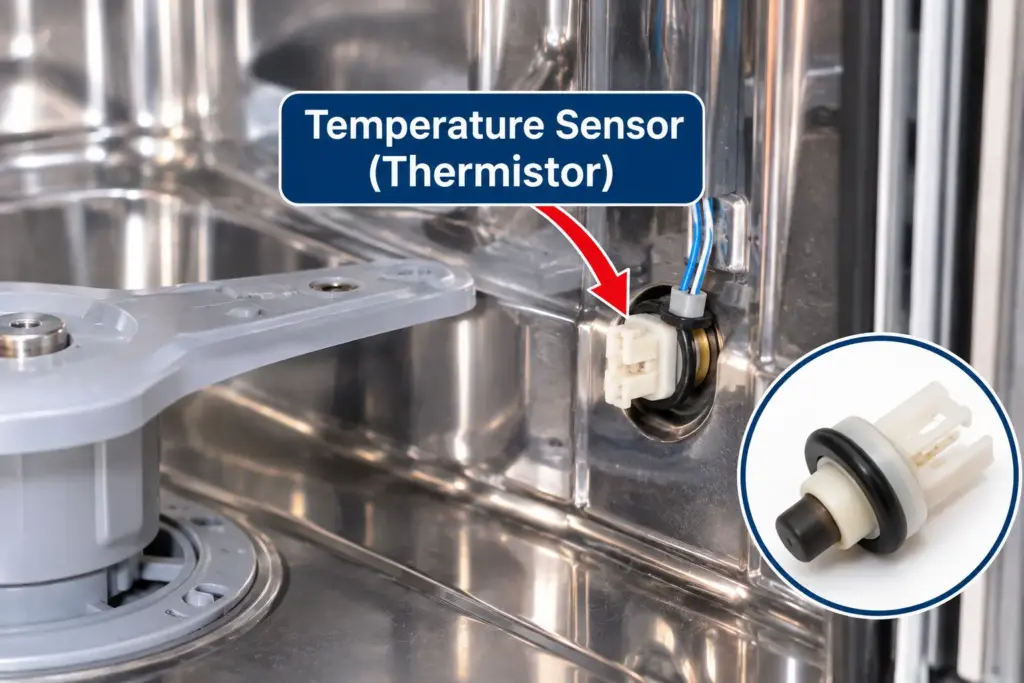
2. Defective Temperature Sensor or Thermistor
The temperature sensor monitors the water temperature and sends information to the dishwasher’s control system.
If the sensor provides inaccurate readings, the dishwasher may not heat the water correctly or may stop heating before the water reaches the required temperature.
Dishwasher Temperature Sensor (Thermistor)
3. Malfunctioning Electronic Control Board
The control board manages different dishwasher functions, including the heating cycle.
If a component on the board fails or the heating circuit is interrupted, the dishwasher may not send the proper signal to activate the heating element.
4. Incoming Water Is Not Hot Enough
Although many dishwashers have their own heating system, they also rely on an adequate hot water supply.
If the water entering the dishwasher is too cold, the appliance may take longer to reach the required temperature. A problem with the home’s water heater or hot water supply can contribute to this issue.
5. Water Circulation Problems
The dishwasher needs proper water circulation to distribute heated water throughout the tub.
A clogged filter, restricted spray arms, or circulation pump problem can interfere with washing performance and may affect how effectively heat is distributed during the cycle.
6. Incorrect Wash Cycle or Settings
Some dishwasher cycles use lower water temperatures or different heating and drying settings to reduce energy consumption.
For example, an Eco or Energy-Saving cycle may use less heat or take longer to complete. If dishes are coming out cold, check the selected cycle and drying options before assuming a component has failed.
Does a Dishwasher Heat Its Own Water?
Most modern dishwashers use an internal heating system to help maintain or raise water temperature during the wash cycle. However, they are also typically connected to the home’s hot water supply.
If your dishwasher is not getting hot, the issue may be related to the incoming water temperature or the appliance’s internal heating system. The exact heating process varies by model, so check the manufacturer’s instructions before assuming the dishwasher heats all the water on its own.
What You Can Check Yourself When Your Dishwasher Is Not Heating Water
Before assuming your dishwasher has a faulty heating element, try these simple checks:
1. Check the Hot Water Supply: Make sure the dishwasher’s water supply valve is fully open and your home has hot water. You can also review the U.S. Department of Energy’s dishwasher guidance for general information about dishwasher energy use and water heating.
2. Check the Wash Cycle: Select a Normal or High-Temperature cycle instead of an Eco or Energy-Saving cycle.
3. Run the Kitchen Hot Water: Let the kitchen faucet run until the water becomes hot before starting the dishwasher, if recommended by the manufacturer.
4. Clean the Dishwasher Filter: Remove food debris and buildup that may restrict water circulation.
5. Check the Spray Arms: Make sure they can rotate freely and their openings are not blocked.
If your dishwasher is still not heating water after these checks, the problem may involve the heating element, temperature sensor, or electronic control board.
Safety Warning: Unplug the dishwasher before cleaning or inspecting accessible components. Never open electrical compartments, test wiring, or attempt to remove the heating element or temperature sensor yourself. These repairs should be handled by a qualified technician.
Safety Tip
Dishwasher water and internal components can remain hot immediately after a wash cycle. Allow the appliance to cool completely before inspecting the interior, and avoid touching the heating element or standing water while they are hot.
When to Stop Troubleshooting and Call a Professional
Stop troubleshooting and contact a qualified technician if your dishwasher is still not heating water after checking the hot water supply, wash cycle, filter, and spray arms.
Call for professional diagnosis if:
-
Your dishwasher runs but the water stays cold.
-
The dishwasher heater is not working.
-
Your dishwasher is not heating or drying dishes properly.
-
A heating-related error code appears.
-
You notice a burning smell, electrical damage, or repeated circuit breaker trips.
Do not attempt to test or replace the heating element, temperature sensor, or control board yourself. These components require proper diagnosis and electrical testing.
If your dishwasher is not heating water, KZ Express provides professional dishwasher repair services in Baltimore and surrounding Maryland communities.
What Happens If You Ignore a Dishwasher Heating Problem?
If your dishwasher is not heating water, ignoring the problem can lead to:
-
Poor Cleaning Results: Dishes may remain greasy, dirty, or covered in detergent residue because the water is not reaching the proper temperature.
-
Reduced Drying Performance: Dishes may come out wet, especially in models that use a heating element for drying.
-
Repeated Wash Cycles: You may need to run the dishwasher again because the first cycle did not clean the dishes properly.
-
Ongoing Component Problems: If the dishwasher heater is not working or the temperature sensor is faulty, the problem will likely continue until the cause is diagnosed and repaired.
Don’t keep relying on repeated wash cycles to compensate for poor heating. If your dishwasher is not heating or drying properly, professional diagnosis can help identify the cause before the problem persists.
How KZ Express Diagnoses and Repairs a Dishwasher That Is Not Heating Water
At KZ Express, we start by identifying why the dishwasher is not heating water rather than replacing parts without confirming the cause.
Our repair process may include:
-
Inspecting the Heating System: Checking the heating element and its connections for visible damage or electrical faults.
-
Testing the Temperature Sensor: Checking whether the thermistor is accurately detecting the water temperature.
-
Checking the Control System: Diagnosing whether the electronic control board is properly controlling the heating cycle.
-
Verifying Water Temperature: Checking whether the incoming hot water supply is adequate.
-
Confirming Proper Operation: Running the appropriate test cycle to verify that the dishwasher heats water as expected.
The repair depends on the diagnosis and dishwasher model. If the dishwasher heater is not working, we identify the faulty component before recommending a repair.
Dishwasher Not Heating Water: Symptoms, Causes & What to Do
| Symptom | Possible Cause | DIY | Call a Technician |
|---|---|---|---|
| Dishwasher water stays cold | Heating element, temperature sensor, or control issue | ✅ Check the hot water supply and selected cycle | If the dishwasher is still not heating water |
| Dishes are not getting clean | Water temperature too low or circulation problem | ✅ Clean the filter and check the spray arms | If poor cleaning continues after basic checks |
| Dishes remain wet after the cycle | Heating or drying system problem | ✅ Check the drying setting and selected cycle | If the dishwasher is not heating or drying properly |
| Detergent does not dissolve completely | Low water temperature, blocked dispenser, or circulation issue | ✅ Check the dispenser and clean the filter | If detergent residue continues after cleaning |
| Dishwasher heater is not working | Faulty heating element, sensor, wiring, or control board | ❌ Do not test or replace electrical components yourself | ✅ Professional diagnosis and electrical testing |
| Heating-related error code appears | Heating system or temperature-sensing fault | ✅ Check the manufacturer’s error-code instructions | If the error returns or the dishwasher does not heat |
Frequently Asked Questions
Why is my dishwasher not heating water?
Common causes include a faulty heating element, temperature sensor, control board, or an inadequate hot water supply.
Why is my dishwasher not getting hot?
Check the selected wash cycle and hot water supply first. If the water remains cold, the heating system may require professional diagnosis.
Does a dishwasher heat its own water?
Many dishwashers use an internal heating system to raise water temperature, but they are also designed to receive hot water from the home’s water supply. Check your manufacturer’s installation instructions for the required inlet temperature.
Why is my dishwasher not heating or drying?
A heating element or temperature-sensing problem can affect both water heating and drying on models that use the heating element for drying. However, drying systems vary by model.
Why is my dishwasher heater not working?
The heating element itself may be faulty, but the temperature sensor, wiring, or control system can cause similar symptoms. Proper testing is needed before replacing the heater.
Why is the water in my dishwasher not getting hot enough?
The incoming water may be too cool, or the dishwasher may have a heating or temperature-sensing problem. Check the hot water supply and cycle settings before calling for service.
Dishwasher Not Heating Water: Final Takeaway
If your dishwasher is not heating water, start with the hot water supply, cycle settings, filter, and spray arms. If the water remains cold or the dishwasher is not heating or drying properly, the problem may involve the heating element, temperature sensor, or control system.
Avoid replacing electrical components without proper testing. For more practical appliance troubleshooting and repair guidance, visit the KZ Express Appliance Repair Tips page.
